Speakers

Overview
This session examined uncertainty from three complementary angles: how the brain encodes it, how curiosity drives us to reduce it, and how economists try to measure and scale it in real-world contexts. One talk presented some novel Bayesian neuroimaging methods to decode trial-by-trial uncertainty directly from visual cortex activity. A second explored non-instrumental curiosity, that is the intrinsic motivation to seek information even when it carries no other reward. A third showed the economics perspective to uncertainty, drawing on large panel datasets to examine how risk preferences form and shift across a lifetime.

Key Points
Uncertainty is encoded probabilistically in visual cortex and observers actually rely on this probabilistic representation when making decisions and reporting confidence, with the insula, ACC, and PFC involved in computing these signals.
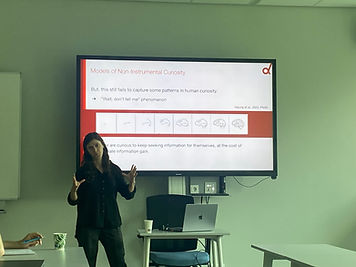
Curiosity peaks at intermediate levels of uncertainty, not at maximum uncertainty, suggesting it is driven by active hypothesis testing rather than simple uncertainty reduction; this can be characterized as a "wait, don't tell me" phenomenon, where people prefer to figure out things themselves, rather than be given the answer.
Traditional economic risk tasks (lottery choice paradigms) are mathematically precise, but ecologically limited; tasks like the Balloon Analogue Risk Task (BART) correlate far better with real-world risky behaviours like smoking and drug use.
Negative life events, which seem to cluster disproportionately among lower socioeconomic groups, shape risk preferences over time in ways that are very complex, with implications for how pension funds should assess clients' risk profiles.
Open question: Do the probabilistic uncertainty representations identified in visual cortex generalise to social and economic uncertainty, and could a shared neural currency for uncertainty underpin decision-making across very different domains?

Next Steps
Possible collaborations: combining formal Bayesian frameworks from neuroscience with ecologically valid task designs from psychology and large-scale panel validation from economics to build a genuinely cross-disciplinary account of uncertainty in human decision-making.
If you are interested in decision-making under uncertainty and would like to connect with the speakers or suggest a speaker for another session, contact us at centerfordecisionscience@ru.nl.